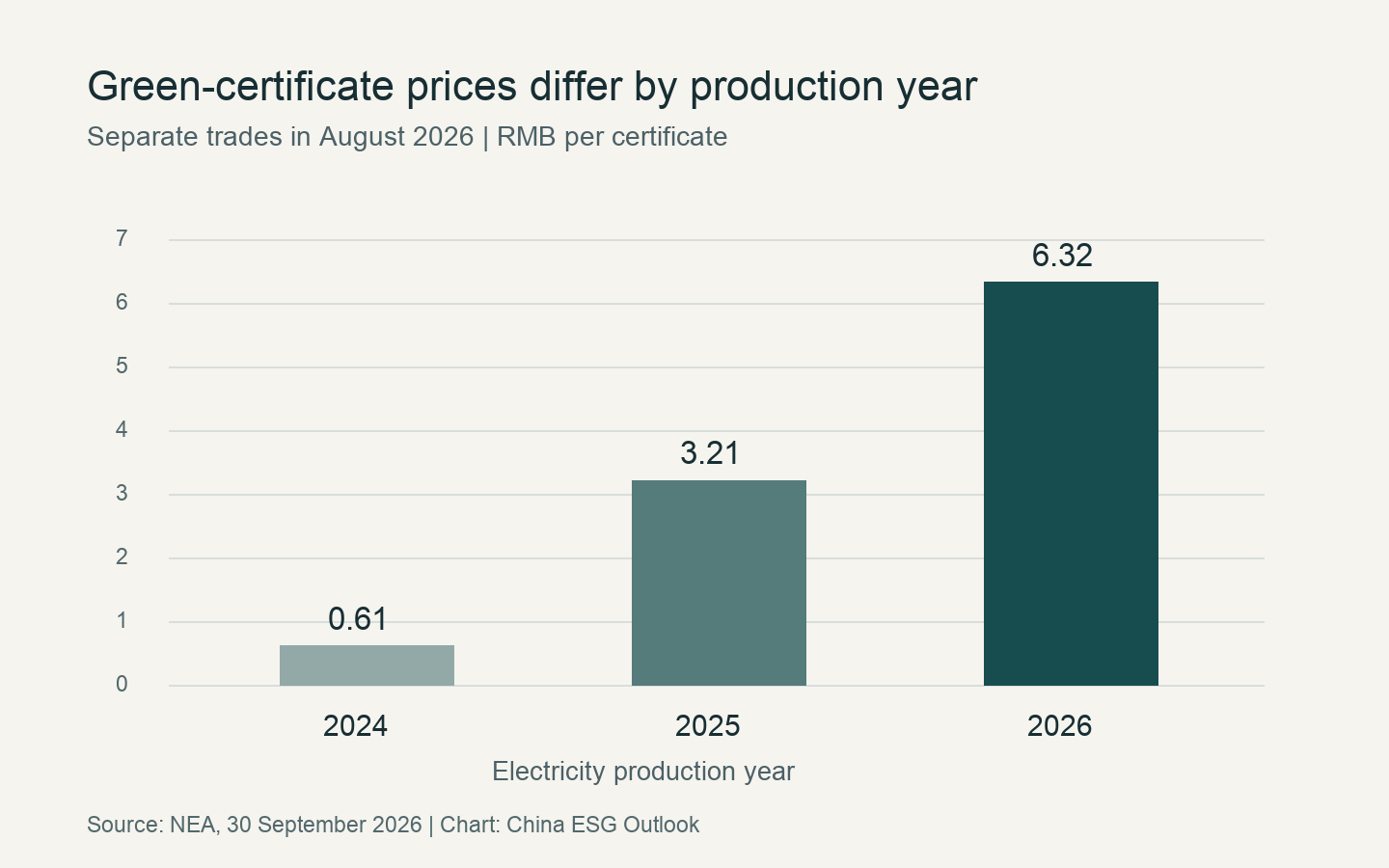
China’s National Energy Administration (NEA) released August green-certificate trading data on 30 September showing a sharp price difference by electricity production year. Separately traded certificates averaged RMB 0.61 for 2024 electricity, RMB 3.21 for 2025 and RMB 6.32 for 2026. For corporate buyers, the useful question is which reporting-period claim a purchase can support. [1]
The production year belongs in the purchase specification
National rules issued in November 2025 specify that, from 1 January 2026, certificates cancelled to declare green-electricity consumption must correspond to electricity produced in the same year as the declared consumption. They also encourage closer time matching. Each certificate represents 1,000 kilowatt-hours of renewable electricity. The date of issuance therefore cannot substitute for the electricity production year. [2]
That distinction changes how a procurement team should compare offers. A low price is useful only after the instrument meets the intended claim’s requirements. A company preparing a 2026 consumption declaration should check production dates before treating an older certificate as a cheaper substitute. This is a procurement implication of the matching rule, rather than a conclusion that every older certificate transaction is improper.
The same rules give certificates a two-year validity period, measured from the electricity production month, and require cancellation for a green-consumption declaration. The registry’s resulting cancellation statement records the holder, quantity, application, consumption period and location. Validity, ownership and eligibility for a particular consumption year are separate checks. [2]
A price signal with limits
August trading totalled 60.55 million certificates: 35.03 million traded separately and 25.52 million accompanying green-electricity transactions. The release reports average prices for the separate-trading segment; those figures are not prices for the electricity itself. It does not identify the buyers’ intended uses or isolate the cause of the production-year price differences. [1]
The July explanation of China’s green-certificate price index describes a national benchmark built from transaction-price data, with January 2025 as its base period. NEA presents it as a reference for purchasing and selling decisions. A benchmark can improve price discovery; it cannot decide whether a specific contract meets a buyer’s reporting needs. [3]
A useful comparison would hold the production year, delivery deadline and intended application constant before assessing price. Buyers should also distinguish an indicative market average from a firm offer. Neither the index explanation nor the August release provides a guaranteed future purchase price. [1] [3]
Build the evidence into the contract
For a manufacturer, the practical control is to agree the intended consumption year and reporting boundary before ordering certificates, then reconcile the delivered instruments with the cancellation record. The procurement specification should make responsibility for an incorrect production year or late delivery explicit. These are suggested controls, not a new checklist imposed by the September data release.
International customers may use different accounting requirements. The evidence checked here establishes the Chinese matching and cancellation rules; it does not establish acceptance under every overseas standard or customer programme. A buyer should confirm the relevant rule before promising a product-level emissions benefit.
For a renewable generator, NEA’s index explanation offers a reference for choosing a sales window, not assured income. [3] Contract planning should distinguish expected certificate receipts from revenue already secured. The business lesson is specific: price comparison belongs after claim eligibility. Buying the least expensive certificate without checking its production year can leave the intended reporting obligation unmet.
Sources & references
Coverage: 30–30 Sep 2026.
Questions or corrections? Contact the editor.